Murlo is a small, yet charming Italian municipality, located in the beautiful region of Tuscany. The territory of Murlo is immersed in the green hills between the provinces of Siena and Grosseto, offering stunning views and a rare tranquility to be found. This corner of paradise is ideal for those seeking a place of retreat and reflection, away from the hustle and bustle of big cities. The municipality's territory covers 114 square kilometers, populated by just over two thousand inhabitants. Despite its small size, Murlo possesses a fascinating and deep history. Given its geographical location, the municipality has seen the passage of different cultures and civilizations over the centuries, each of which has left its indelible mark. The history of Murlo begins in prehistoric eras. Archaeologists have discovered traces of human settlements dating back to the Paleolithic and Neolithic periods. Even more significant in Murlo's historical context are the Etruscan finds, as the area was an important center of this ancient and mysterious civilization. The Etruscan discoveries demonstrate a stable and developed presence throughout the territory of Murlo, rather than isolated settlements. The medieval period was another significant moment for the municipality. Over the centuries, Murlo has seen the construction of castles, monasteries, and churches, evidence of a lively period of faith and devotion. At the same time, the presence of fortifications reveals the strategic importance of this territory in the past. The urban structure of Murlo bears witness to the various historical eras it has gone through. The municipality is composed of a set of hamlets, each with its own history and character. Among these, the hamlet of Vescovado is probably the most important, as it has been the residence of the bishops of Siena for centuries. In addition to history, the natural environment of Murlo is another highlight of the municipality. The territory is characterized by wooded hills, covered with oaks and chestnuts, interspersed with fertile valleys where vineyards and olive groves are cultivated. The landscape is completed by the rivers Merse and Ombrone, which delimit the municipality's territory. From an economic point of view, like many other parts of Tuscany, Murlo is a rural area. Agriculture plays an important role, with the production of wine, olive oil, and honey. Nevertheless, the municipality has also developed a tourist sector, thanks to its historical and natural beauty. The local society is composed of people who proudly preserve their culture and traditions. There are annual festivals, local fairs, and community meetings aimed at keeping Murlo's history alive. In conclusion, Murlo is a Tuscan municipality that offers a lot to its visitors. A fascinating history, a charming natural environment, and a welcoming community are just some of the aspects that make Murlo a unique place. If you are looking for a corner of tranquility and beauty in the heart of Tuscany, Murlo is a place you shouldn't miss.
No membership group specified.
Murlo, a splendid gem nestled in the heart of Tuscany, boasts a rich tradition of local entrepreneurship that supports the economy of the municipality and enhances the territory and its resources. Local businesses reflect the creative and hardworking spirit of its inhabitants, promoting a model of sustainable development, along with respect for the cultural and historical roots of the place. Among the most prominent business activities in Murlo are those related to viticulture. The municipality is known for the production of high-quality wines, thanks to the extraordinary vineyard landscapes that are part of it. Numerous family wineries and small producers offer refined and precious labels, born from the combination of an ancient winemaking tradition and innovative techniques. These wines, pride of local production, manage to conquer both the national and international markets. Another sector of central importance for the economy of Murlo is agriculture. Here, nature and human labor merge in perfect harmony, giving life to products of the highest quality. Local agricultural companies, often family-run, are dedicated to the cultivation of olives, cereals, and the production of honey, cheeses, and typical products of Tuscan gastronomy. These activities are a pillar for the local economy, as well as a determining factor for the landscape and the preservation of rural traditions. In addition to viticulture and agriculture, Murlo boasts a very diverse artisanal scene. Numerous artisans offer a wide range of products, from wood to wrought iron, from ceramics to textiles. The workshops in Murlo keep alive ancient processing techniques, handed down from generation to generation, contributing to preserving the cultural identity of the municipality. The tourism sector, then, plays a fundamental role in supporting the local economy of Murlo. While maintaining its characteristics as a rural village, the municipality has managed to attract national and foreign visitors with the beauty of its territory, the richness of its historical and cultural heritage, and the excellent food and wine. Numerous bed and breakfasts, agritourisms, restaurants, and tourist services increase the livability and attractiveness of Murlo, contributing to the socio-economic development of the municipality. Finally, the services sector also plays an important role in the local businesses of Murlo. From grocery stores to household products, from transportation services to maintenance services, the service businesses in Murlo are a reference point for residents and visitors. They play a fundamental role in daily life, ensuring the well-being of the population and the livability of the municipality. Thanks to this variety of local businesses, the municipality of Murlo represents a true jewel of Tuscany, a place where tradition and innovation coexist in a harmonious and sustainable manner, enhancing its resources and contributing to the well-being of the community.
The small municipality of Murlo, with the Istat code 52019, is located on the hills of Val d'Arbia, in the heart of Tuscany. This area, characterized by a territorial surface of 114.6247 sq km, includes a population of 2,474 inhabitants, distributed almost evenly between males (1,292) and females (1,182), offering a good demographic variability. The territory also sees the presence of a significant foreign community of 316 individuals, constituting a significant 13% of the total population, indicating the presence of a multi-ethnic culture and an open and inclusive society. In the territory of Murlo, the dwellings range from occupied (1,065) to unoccupied (735), with a total of 1.8 dwellings, offering growth potential for real estate investors, considering also the charm of the Tuscan countryside, loved not only by Italians but also by foreigners. Regarding accessibility, Murlo is located at manageable distances from major transport infrastructures, 51 minutes from railway stations, 47 minutes from motorway access points, 83 minutes from airports, and 79 minutes from ports with passenger services. This location is therefore favorable for tourist and commercial activities as well. The local tourism offer details the existence of three-star hotels (48 beds), tourist-residential facilities, and other non-hotel accommodation structures, such as agritourism and rental accommodations, for a total of 1,049 beds. Furthermore, the tourism sector could be further developed and improved through investment in new structures and services, with particular attention to luxury facilities given the absence of 4 and 5-star hotels. The tourist attraction of Murlo is further strengthened by the presence of a museum institute that, in 2020, recorded 2,147 visitors. Investments aimed at enriching the cultural offer could be planned here, expanding or diversifying the proposed museum proposals. From a geographical and morphological point of view, in addition to 80% of the territory having an altitude between 0 and 299 meters, the remaining 29% extends up to 599 meters. This characteristic expands investment opportunities in outdoor activities, from trekking to agritourism, from cycling tourism to the enhancement of local food and wine products. Finally, the social aspect should not be forgotten: Murlo falls within sparsely populated areas, which can represent an advantage in terms of tranquility and quality of life, but also a disadvantage for commercial activities that require a larger user base. While on one hand there may be more interest from those seeking a refuge from city stress, on the other hand difficulties may be encountered for those entrepreneurial initiatives that require a significant influx of the public. In conclusion, the territory of Murlo offers various investment opportunities, especially in the tourism-real estate sector, with potential developments also in the cultural and agri-food sectors. By carefully analyzing the demographics, geography, and existing resources, an investor can make the most of this territory rich in potential.
In the heart of Tuscany, between the Crete Senesi and the Val di Merse, Murlo is not simply a medieval village, but a true Etruscan enigma, a place whose identity is shaped by one of the most extraordinary archaeological discoveries of the 20th century. Its worldwide fame comes not from festivals or churches, but from the mystery of an ancient people and their unique and indecipherable art.
The soul of Murlo lies in its hidden treasure: the site of Poggio Civitate, a grandiose Etruscan princely residence from the 7th century BC, one of the largest and most important ever discovered. The artifacts discovered here, preserved in the magnificent Etruscan Museum within the village, have left scholars speechless. Among them all, the famous acroterial statue, nicknamed "the Cowboy of Murlo," stands out: a male figure with a very wide-brimmed hat, an iconography unparalleled in the entire Etruscan world and which has become the symbol of the mystery of this place.
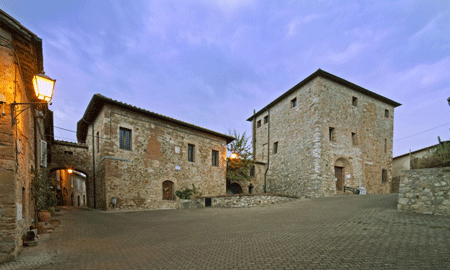
The village itself is a jewel of defensive architecture. Murlo is its castle: a perfect ring of medieval walls enclosing the houses, with a single entrance gate. The highest point is not a fortress, but the Bishop's Palace, which today houses the museum, symbolizing how the ancient Etruscan treasure is the true heart of the town's power and culture. Inside this stone treasure chest, the Church of San Fortunato, the village's patron saint, watches over the community.
Murlo's traditions are not generic porchetta festivals, but events that celebrate its uniqueness. The most important event of the year is "Bluetrusco," a festival held in July that brilliantly blends the Etruscan soul of the place ("blue" like the Etruscan color of mourning, but also like the "blues") with music, art, gastronomy, and historical reenactments. During the feast of the patron saint, San Fortunato, the village comes alive, but it is "Bluetrusco" that truly expresses Murlo's identity in all its originality.
In conclusion, Murlo is a destination that offers a completely different experience. It is a journey into an archaeological mystery, an encounter with a powerful and indecipherable art that continues to question the present. Visiting Murlo means walking in the footsteps of an enigmatic people, being fascinated by their "cowboy" spirit, and discovering how a small medieval village can be the guardian of one of the most fascinating stories of ancient Italy.